
What Is a GaN PD Charger? Technology, Benefits & How It Works
Smartphones, tablets, laptops and other portable electronics are demanding more charging power while consumers expect chargers to become smaller, lighter and more efficient. This has accelerated the adoption of GaN PD chargers, which combine Gallium Nitride (GaN) power semiconductor technology with USB Power Delivery (USB PD).
But what exactly is a GaN PD charger, how does it work, and why is GaN increasingly replacing conventional silicon technology in high-performance USB chargers?
This technical guide explains the technology from the power-conversion stage to USB-C power negotiation.
What Is a GaN PD Charger?
A GaN PD charger is a high-efficiency AC-to-DC power adapter that uses Gallium Nitride power devices together with USB Power Delivery technology to provide intelligent, high-power charging through USB-C.
The two technologies perform different functions:
GaN (Gallium Nitride) improves the efficiency, switching performance, power density and thermal characteristics of the charger’s power-conversion stage.
USB PD (Power Delivery) provides intelligent communication between the charger and connected device so that the appropriate charging voltage and current can be negotiated.
Together, these technologies allow manufacturers to design chargers capable of delivering significantly more power from a compact enclosure.
What Is GaN Technology?
Gallium Nitride is a wide-bandgap semiconductor material increasingly used in high-frequency power electronics.
Traditional chargers commonly use silicon MOSFETs as their primary switching devices. Silicon technology is mature and economical, but switching losses, device capacitances and other physical limitations become increasingly important as designers push toward higher switching frequencies and greater power density.
GaN power devices offer characteristics that can make them highly attractive for modern charger designs, including:
High switching speed
Low switching losses
Low device capacitance
High power density
Reduced high-frequency switching losses
Potentially smaller magnetic components
Improved efficiency at high switching frequencies
This does not simply mean that "GaN produces more power."
The important engineering advantage is that GaN enables power converters to operate efficiently at higher switching frequencies, allowing the overall power supply to become smaller without sacrificing performance.
Why Can GaN Chargers Be Smaller?
The physical size of an AC-DC charger is determined not only by its semiconductor devices but also by components such as transformers, inductors, capacitors, EMI filters and thermal-management structures.
In a switched-mode power supply, increasing switching frequency can allow certain magnetic components to become smaller.
However, with conventional silicon switches, increasing switching frequency can significantly increase switching losses.
GaN devices can reduce these losses.
This gives the power-supply designer an opportunity to operate at higher frequencies while maintaining acceptable efficiency and temperature.
The result can be:
Higher switching frequency → smaller magnetics → higher power density → smaller charger
This is one of the fundamental reasons why a properly engineered MELCON GaN charger can deliver 20W,35W, 45W, 65W or higher power from an enclosure considerably smaller than many conventional power adapters.
What Does PD Mean in a GaN Charger?
PD stands for USB Power Delivery.
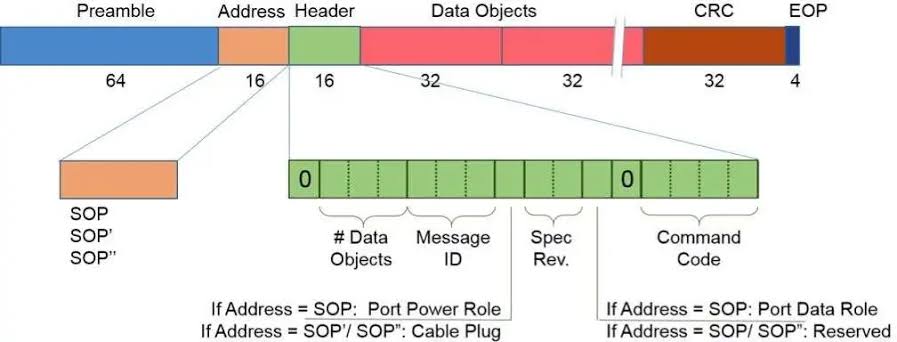
USB PD is much more than simply providing 5V through a USB connector. It is a communication-based charging system in which the source (charger) and sink (connected device) communicate before higher power is supplied.
This communication takes place through the USB Type-C configuration channel.
When a compatible device is connected, the charger advertises the power profiles it can support. The device requests an appropriate operating condition, and the charger then regulates its output accordingly.
Depending on charger and device capabilities, commonly encountered fixed-voltage profiles include:
5V, 9V, 12V, 15V and 20V
The exact profiles and available current depend on the charger's USB PD implementation and rated output power.
This negotiation is an important safety and compatibility feature because a PD charger does not simply apply its maximum voltage to every connected device.
How Does a GaN PD Charger Work?
A modern GaN PD charger can be understood as several interconnected functional blocks.
1. AC Input and Protection
The charger receives mains AC input.
The input section can include components for:
Fuse or fusible protection
Surge protection
Inrush-current management
EMI filtering
Rectification
A robust input design is particularly important for chargers intended for long-term operation under varying mains conditions.
2. AC-to-DC Conversion
The incoming AC voltage is rectified into high-voltage DC.
Depending on charger power level and architecture, the power converter may use topologies such as flyback or other high-frequency conversion techniques.
In a GaN charger, the high-frequency switching element uses GaN power technology instead of a conventional silicon MOSFET implementation.
3. High-Frequency Switching
The controller switches the GaN power device at high frequency.
This converts the rectified input power into high-frequency energy that can be transferred through the transformer.
The transformer performs essential energy-transfer and, in isolated charger designs, electrical-isolation functions.
4. Secondary-Side Rectification
On the transformer secondary side, the high-frequency waveform is converted back into DC.
High-efficiency designs may use synchronous rectification, where a controlled MOSFET replaces or supplements conventional diode rectification to reduce conduction losses.
5. Output Filtering and Regulation
Capacitors and associated filtering components smooth the converted power to create a stable DC output.
The control system continuously regulates the output according to the voltage requested by the connected device.
6. USB-C PD Controller
This is where the "PD" function becomes important.
The PD controller communicates with the connected USB-C device and determines the requested power profile.
For example, a device may request:
5V at one operating condition,
9V for faster smartphone charging,
or a higher-voltage profile for compatible tablets and laptops.
The power converter then adjusts its output according to the successfully negotiated profile.
Understanding PPS – Programmable Power Supply
Advanced USB PD chargers may also support PPS (Programmable Power Supply).
Unlike fixed PDO charging, where the charger provides predefined voltage levels, PPS allows compatible devices to request voltage and current adjustments within supported ranges.
This gives the device greater control over the charging process.
One important benefit is that some voltage conversion can be optimized between the charger and the device, which can help improve charging efficiency and thermal performance in compatible charging systems.
PPS support is particularly relevant to many modern fast-charging smartphones.
However, both the charger and the connected device must support compatible PPS operation for PPS charging to be used.
GaN Charger vs Conventional Silicon Charger
| Parameter | Conventional Silicon Charger | GaN Charger |
|---|---|---|
| Power semiconductor | Silicon | Gallium Nitride |
| Switching capability | Conventional | High-frequency capable |
| Switching losses | Typically higher at very high frequency | Can be lower |
| Power density | Moderate | Potentially higher |
| Charger size | Generally larger for equivalent design | Can be smaller |
| Thermal design | More challenging as power density increases | Can offer efficiency advantages |
| High-power USB-C application | Possible | Particularly well suited |
| 45W/65W compact designs | Larger design may be required | Highly suitable |
GaN should therefore not be viewed merely as a marketing feature.
Its value comes from the power-conversion advantages available to engineers when the entire charger is designed around the characteristics of GaN devices.
What Is Charger Power Density?
Power density describes how much output power a charger can deliver relative to its physical volume.
For example, two chargers may both deliver 65W, but the charger delivering that power from a significantly smaller enclosure has greater power density.
GaN technology can enable higher power density because reduced switching losses and higher-frequency operation can allow several components in the power converter to be optimized.
However, achieving high power density requires careful engineering.
Simply replacing a silicon MOSFET with a GaN device does not automatically create a high-quality GaN charger.
The transformer design, PCB layout, thermal management, EMI performance, control loop, isolation, component selection and mechanical design must all work together.
Why Thermal Management Still Matters in GaN Chargers
A common misconception is that GaN chargers do not generate heat.
Every real power converter has losses.
These can include:
Switching losses
Conduction losses
Transformer losses
Rectifier losses
Copper losses
Control-circuit consumption
GaN technology can reduce important semiconductor switching losses, but a compact charger still needs effective thermal engineering.
PCB copper area, component placement, thermal interfaces, transformer construction, enclosure material and airflow characteristics can all influence operating temperature.
For professional OEM buyers, thermal performance under continuous full-load operation is often more important than simply comparing charger dimensions.
What Protections Should a Good GaN PD Charger Have?
A professionally designed charger should incorporate appropriate electrical and thermal protection mechanisms.
Depending on the design, these can include:
OVP – Over Voltage Protection
Protects against excessive output voltage.
OCP – Over Current Protection
Limits excessive output current.
SCP – Short Circuit Protection
Protects the charger when the output is short-circuited.
OTP – Over Temperature Protection
Reduces or shuts down operation if unsafe temperature conditions occur.
Additional protection and control functions may also be incorporated depending on the power architecture.
For OEM applications, protection behaviour should be evaluated under actual operating conditions rather than relying only on the presence of protection terminology in a datasheet.
Why USB-C Cable Quality Matters
A charger is only one part of the fast-charging system.
Actual charging performance depends on:
Charger + USB cable + connected device + supported charging protocol
A poor-quality or incorrectly rated cable can prevent the system from reaching its intended power level.
At higher USB-C power levels, cable capability and electronic identification requirements become increasingly important.
Therefore, when troubleshooting a PD charging issue, engineers should verify not only the charger but also:
USB-C cable rating
CC communication
PD negotiation
Device-supported PDOs
PPS compatibility
Connector condition
Actual voltage and current under load
Does a 65W GaN Charger Always Charge at 65W?
No.
A 65W charger rating represents its maximum supported output capability under specified conditions.
The connected device determines how much power it requests within the mutually supported charging profiles.
For example, connecting a lower-power smartphone to a 65W charger does not mean the charger continuously forces 65W into the phone.
The USB PD system negotiates an appropriate power level.
This is one of the major advantages of standards-based intelligent charging.
What Devices Can Use GaN PD Chargers?
Depending on their supported output profiles and protocols, GaN PD chargers can be suitable for:
Android smartphones
iPhones
Tablets
iPads
USB-C laptops
Ultrabooks
Power banks
Wireless charging devices
Portable gaming devices
Industrial USB-C powered equipment
Other USB-C PD compatible electronics
Compatibility should always be confirmed against the charger's supported voltage/current profiles and the device manufacturer's requirements.
What Should OEM Buyers Check Before Selecting a GaN PD Charger?
For OEMs, distributors and private-label brands, charger selection should go beyond wattage and enclosure appearance.
Important technical parameters include:
Rated continuous output power
Supported USB PD profiles
PPS support and ranges
Supported fast-charging protocols
Conversion efficiency
Full-load temperature rise
No-load power consumption
Output ripple and noise
Short-circuit behaviour
Over-voltage and over-current protection
Input surge performance
EMI/EMC performance
Electrical isolation
Creepage and clearance
Transformer insulation system
PCB and component quality
Connector durability
Cable compatibility
Reliability testing
Applicable safety and regulatory compliance
For serious OEM programs, these parameters should be verified through engineering validation and production-quality controls.
GaN PD Charger Manufacturer in India – MELCON
MELCON GaN PD chargers are developed for customers looking for high-efficiency, compact and technically engineered fast-charging solutions manufactured in India.
Our product development approach focuses on the complete power-conversion system rather than only headline wattage.
MELCON's GaN PD charger portfolio includes multiple power configurations for consumer, OEM, private-label and industrial requirements.
Available product categories include:
20W PD fast chargers
35W GaN PD chargers
45W GaN PD chargers
65W GaN PD chargers
USB Type-C outputs
USB Type-A + Type-C configurations
PD and PPS compatible designs
OEM and private-label charger solutions
OEM & Private-Label GaN PD Charger Solutions
For brands looking to source Made-in-India PD chargers, MELCON can support OEM and private-label requirements based on project specifications.
Typical requirements can include:
Custom branding
Private labelling
Packaging
Output-power selection
USB-A + USB-C configurations
Protocol requirements
Electrical performance specifications
Product reliability testing & 100% burn-in testing.
Production-volume requirements
This makes GaN PD technology suitable not only for retail chargers but also for brands seeking an Indian manufacturing partner for their charging-product portfolio.
Frequently Asked Questions About GaN PD Chargers
Is GaN better than silicon for chargers?
GaN offers important advantages for high-frequency power conversion, particularly where high efficiency and high power density are required. However, final charger performance depends on the complete electrical, thermal and mechanical design.
Is a GaN charger safe for smartphones?
A correctly designed charger using compatible USB PD protocols negotiates the required power with the connected device. Safety ultimately depends on charger design quality, protection circuits, manufacturing quality and applicable compliance requirements.
What is the difference between GaN and PD?
GaN is the semiconductor technology used in power conversion, while PD is the USB communication and power-delivery standard. They perform completely different functions but complement each other in a modern fast charger.
What is PPS in a PD charger?
PPS stands for Programmable Power Supply. It allows compatible devices to request dynamically adjustable voltage/current conditions within the charger's supported PPS ranges.
Is a 65W GaN charger suitable for a laptop?
It can be, provided the laptop supports USB-C PD and its required voltage/current profile is supported by the charger. Always verify the laptop's power requirements.
Why are GaN chargers smaller?
GaN devices can operate efficiently at high switching frequencies. This can allow smaller transformers and other magnetic components while maintaining high conversion efficiency, resulting in increased power density.
The Future of Compact Power Conversion
GaN represents an important development in power electronics because it enables engineers to push switching frequencies and power density beyond many practical limitations encountered with conventional silicon implementations.
Combined with USB Power Delivery, PPS and intelligent charging protocols, GaN technology makes it possible to build compact chargers capable of powering everything from smartphones to laptops.
For consumers, this means smaller chargers, higher available power and greater charging flexibility.
For OEMs and product brands, it creates an opportunity to develop compact, high-performance charging products while reducing dependence on bulky conventional adapters.
As USB-C continues to expand across consumer, commercial and industrial electronics, GaN + USB PD is becoming an increasingly important combination for next-generation power adapters.
Looking for an OEM GaN PD Charger Manufacturer in India?
MELCON offers GaN PD fast-charging solutions for OEM, private-label, distribution and industrial requirements.
For product specifications, samples, bulk requirements or OEM development enquiries:
Email: sales@melconindia.com
WhatsApp: +91-9356284364
Website: https://www.melconindia.in
MELCON – Powering Smarter Electronics.